
Media
HKUMed reveals policies and service measures that may enhance esketamine's value for treatment-resistant depression
24 Aug 2026
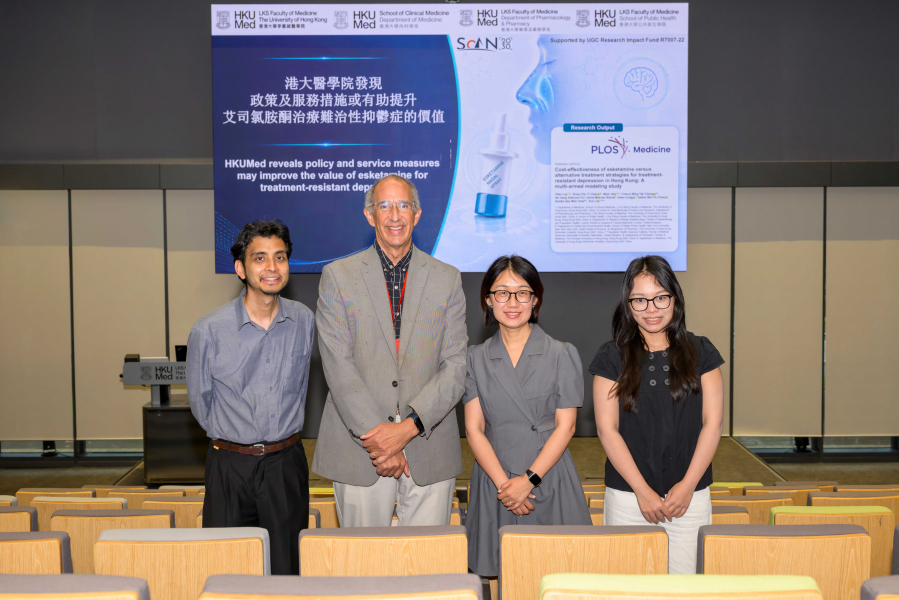
The study led by Professor Shirley Li Xue (second right) finds that a combination of policies and service measures could enhance the value and affordability of esketamine nasal spray, a novel rapid-acting treatment for adults with treatment-resistant depression (TRD) in Hong Kong.
A joint research team led by the LKS Faculty of Medicine of the University of Hong Kong (HKUMed), in collaboration with The Chinese University of Hong Kong, New York University and Newcastle University, has found that a combination of policies and service measures could enhance the value and affordability of esketamine nasal spray, a novel rapid-acting treatment for adults with treatment-resistant depression (TRD) in Hong Kong. The study found that measures such as price negotiation, value-based access arrangements, optimised service delivery and targeted patient selection could help make esketamine more accessible while maintaining the sustainability of the healthcare system. The findings were published in PLOS Medicine [link to the publication].
Depression remains a significant public health challenge globally, particularly for people living with TRD. TRD occurs when a person does not respond adequately to at least two antidepressant treatments. ‘Patients often experience persistent symptoms, impairing daily work and life, and increasing reliance on healthcare services even when receiving standard treatments. There is an urgent need for innovative treatment options that can offer hope for patients who have exhausted conventional therapies,’ said Professor Shirley Li Xue, Assistant Professor in the Department of Medicine of the School of Clinical Medicine and the Department of Pharmacology and Pharmacy at HKUMed.
Esketamine shows clinical promise as a rapid-acting treatment
Esketamine nasal spray is a novel antidepressant treatment used together with an oral antidepressant. While traditional antidepressants can take weeks to work and are not effective for every patient, esketamine has attracted global attention for its rapid-acting effects and unique mechanism of action.
However, esketamine is costly and requires supervised administration by healthcare professionals, which may limit its affordability and scalability in publicly-funded healthcare settings. The research team emphasised that consideration of its wider adoption should be informed by clinical effectiveness and by value-based assessment, service capacity and policy design.
Multi-armed modelling informs value-based treatment planning
To understand the potential role of esketamine in Hong Kong's healthcare system, the research team conducted a comprehensive economic evaluation using a Markov cohort model, comparing esketamine combined with antidepressant treatment against six commonly used third-line treatment strategies for adults with TRD in Hong Kong over a five-year period. These strategies included combination antidepressant therapy, augmentation therapy, psychotherapy alone, psychotherapy plus antidepressant treatment, repetitive transcranial magnetic stimulation (rTMS) and electroconvulsive therapy (ECT). By applying local data and decision modelling to TRD, the research supports more informed treatment sequencing and value-based policy planning for mental health care in Hong Kong.
The study found that esketamine was associated with greater health gains than most of the other strategies evaluated. Over five years, esketamine treatment generated 2.95 quality-adjusted life-years (QALYs), a commonly used measure of health outcomes that reflects both survival and quality of life. This was higher than the results of combination therapy, augmentation therapy, psychotherapy-based treatments and rTMS.
However, these additional health gains came with substantially higher treatment and monitoring costs. For example, compared with combination antidepressant therapy, esketamine led to better estimated health outcomes, but the additional cost to gain one extra year of life in good health was about US$274,000. However, esketamine appeared more cost-effective than rTMS and ECT.
Instead of focusing solely on whether esketamine should be adopted, the study examined how its value could be enhanced through smarter healthcare policies. Researchers found esketamine's affordability and value depend on several factors, including price negotiation, service delivery models, alternative dosing strategies, appropriate patient selection and value-based reimbursement.
A comprehensive assessment framework for innovative medicines
Professor Shirley Li Xue said, ‘The research findings show that decisions about innovative medicines should be based not on a single clinical or economic factor, but on a comprehensive value-based framework that considers patient outcomes, healthcare resources and long-term sustainability to ensure that patients who are most likely to benefit can access these medicines in a way that is appropriate and sustainable.’
Building on these findings, the SCAN-2030 team, coordinated by Professor Shirley Li Xue, is launching DECODE (Decision Co-Creation Exercise for Defining Value in Healthcare), bringing together policymakers, healthcare professionals, patients, researchers and industry representatives to define what ‘value’ means in healthcare and to help inform decisions on how innovative medicines should be funded and used in Hong Kong's healthcare system.
About the research team
The research was co-led by Professor Shirley Li Xue, Assistant Professor in the Department of Medicine of the School of Clinical Medicine and the Department of Pharmacology and Pharmacy; and Professor Sandra Chan Sau-man, from The Chinese University of Hong Kong. The first authors are PhD candidate Li Yifan and Dr Vivien Chan Kin-yi, from HKUMed. Other co-authors include Professor David Makram Bishai, from the School of Public Health, HKUMed; Professor Esther Chan Wai-yin, Dr Edmund Yiu Hei-hang and Dr Franco Cheng Wing-tak, from the Department of Pharmacology and Pharmacy, HKUMed; Professor Mark Jit, from New York University; and Professor Dawn Craig, from Newcastle University.
Acknowledgements
This research was supported by the UGC Research Impact Fund and conducted under the HKU SCAN-2030 initiative, which aims to inform policy decisions on innovative medicines and future healthcare needs in Hong Kong. More information about SCAN-2030 is available at https://scan2030.hku.hk/.
Media enquiries
Please contact LKS Faculty of Medicine of The University of Hong Kong by email (medmedia@hku.hk).
 Facebook
  HKU IOS App
  HKU Android App
  Social Media and Apps